

A COMPANY BRIEF FROM BOCA RATON
You don’t have a traffic problem.
You have a memory problem.
Every year American companies spend hundreds of billions of dollars to meet the same people for the first time, again. Totaligent was built to stop that. One audience. Every channel. One source of truth — and the infrastructure for the agents that will run it.
Act I of artificial intelligence was infrastructure. Chips. Clusters. Data centers. The winners were obvious because the product was a machine you could photograph.
Act II is not a machine. It is a disappearance. Companies are no longer asking whether to “add AI.” They are asking which layers of software they can stop paying for once an agent can write the page, pick the audience, send the message, buy the media, and read the result from a single room.
McKinsey still describes most organizations as early in that journey. In 2025, 88 percent of companies said they used AI somewhere. Almost none had scaled it into the way work actually happens. Employees are ready. The stack is not.
That gap is the entire business.
THE THESIS
The INDUSTRY sells you a moment.
Then it sells you the same moment tomorrow.
Open a modern growth stack and count the tabs. Email lives in one product. SMS in another. Short links in a third. The landing page was built somewhere else. The pixel talks to a tag manager that talks to a CDP that talks to a DSP that talks to a dashboard nobody trusts by Friday.
Gartner’s 2025 survey found marketers using about 49 percent of the capabilities they already pay for. Martech still eats roughly 22 percent of the marketing budget. For a billion-dollar company at average utilization, Gartner has put the wasted spend in the millions. ChiefMartec now counts more than 15,000 marketing-technology products. Enterprise stacks of sixty tools are ordinary. Utilization is not.
The invoice is only the first tax. The second tax is amnesia.
U.S. internet advertising hit $294.6 billion in 2025, up 13.9 percent — the highest figure in the thirty-year IAB/PwC series. Programmatic buying alone reached $162.4 billion. Typical conversion on a site or a landing page is still under 3 percent. The operating system of the industry is this: ninety-seven out of one hundred people leave, and you pay to meet them again as if you had never met them.
The internet feels infinite. The buyer is not. There are on the order of 205 million Americans between 18 and 64. Narrow that by income, zip code, profession, and the actual job your product does, and the relevant market is a small town wearing a big costume. Most “new” demand is a second, third, or tenth bid for someone already seen.
Platforms understand this perfectly. They sell attention, not loyalty. They keep the relationship. You keep the receipt.
AI does not fix that by writing a better subject line. AI fixes it only if the system underneath can remember who engaged, on which channel, with what creative, and whether they already said no. Without that memory, an agent is just a faster way to rent the same stranger.
We did not bolt a chatbot onto the stack.
We built the room the agent walks into.
Totaligent is one environment for the work that is currently scattered across a dozen contracts: email, SMS, MMS, voice, push, short links, first-party cookies, social, search and display, programmatic, connected television, and out-of-home — on a shared audience and a shared ledger of what happened.
Setup is designed for minutes, not a quarter. Smart Links for attribution. Smart Cookies to grow a first-party pool instead of borrowing someone else’s. Smart Engage to follow a visitor the same day, by email or SMS, while the intent is still warm. Smart Capture to turn anonymous traffic into a record you can actually use.
From the same desk the system can draft the landing page, spin the A/B variants, and cut the ad units in the sizes each channel demands. Click monitoring, campaign comparison, IP reputation, and audience detail do not live in five CSVs. They live in one picture, in real time.
Underneath: commercial-grade Laravel, a data-management platform on GPU shards, enough memory to model the audience while the campaign is live. Native functions where other products insert an API, a markup, and another login. The architecture was drawn before generative models were a consumer product. The models did not force a pivot. They finally gave the building an occupant.
The Rented Stack
Buy the click. Lose the person.
One vendor per channel. One truth per vendor.
Attribution that arrives after the budget is gone.
AI as a feature bolted onto last year’s tool.
You rent the audience. They keep the graph.
The Owned System
Capture the person. Keep the conversation.
Every channel. One audience record.
See the click, the send, and the spend in one place.
AI as the operator of the system, not a widget in it.
You own the graph. The next message is yours.
Point an agent at an objective — five hundred qualified leads, recover the warm exits, stop paying for exhausted inventory — and the agent has somewhere to stand. That is the difference between “AI marketing” as a slogan and AI as a worker.
In March 2025 we opened the public beta. In December we finished quality-assurance across every core module and entered 2026 with the full platform operational. The Founders program is how early operators get inside while the category is still being rewritten.
The field is not theoretical. It already clears a quarter of a trillion dollars a year.
We do not need a new category name. The money is already being spent. It is simply being spent in pieces that refuse to share a customer.
IAB’s 2026 Outlook Study forecasts 9.5 percent growth in U.S. ad spend, with digital still in front — social +14.6 percent, connected TV +13.8 percent, commerce media +12.1 percent. Five of the six top marketer priorities in that survey are AI-driven. IAB’s own language has moved from experimentation to systems that can plan, activate, and optimize without a human at every step.
That is the window. Not “more tools with a sparkle icon.” The operating layer between a brand and every impression it buys.
The market has already paid billions for the pieces.
Almost nobody owns the whole room.
Read the comparables the way an operator would. Each of these companies won by owning one wall of the house Totaligent is trying to stand up as a single structure.
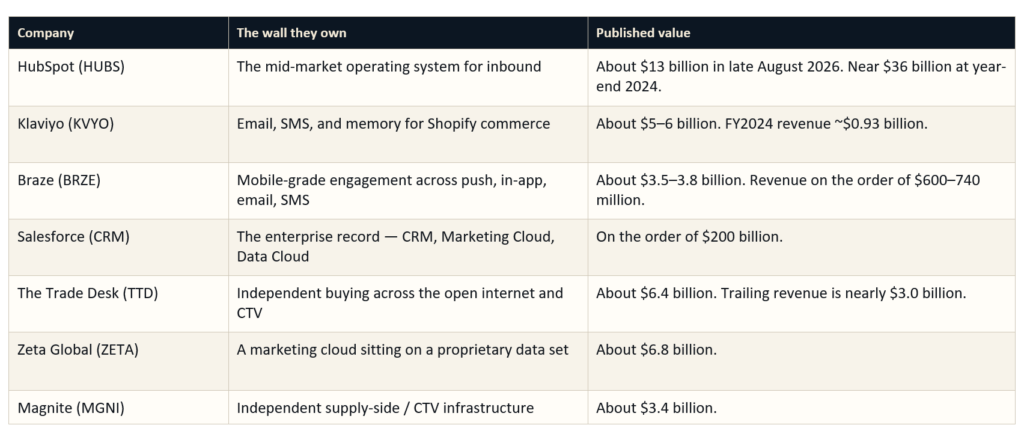
Private companies and the checks that closed
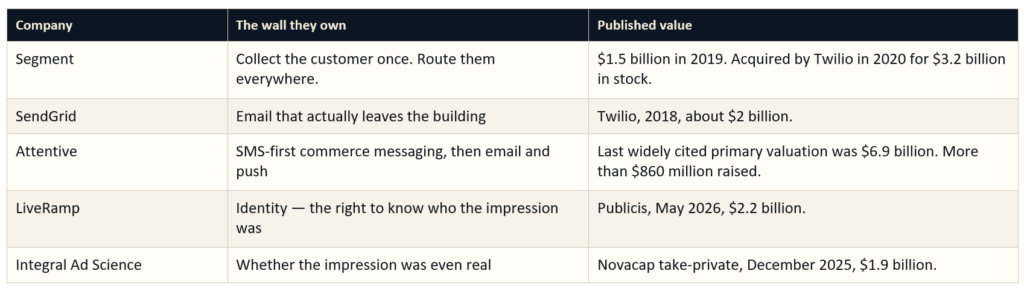
Two facts survive any argument about multiples.
First: the market has repeatedly paid billions for a slice — the pipe, the inbox, the text message, the bid, the identity graph. Second: in 2025–2026 public software multiples compressed (HubSpot itself is worth a third of its 2024 peak) while strategic buyers kept writing nine-figure and ten-figure checks for memory and verification. The category is not dying. It is being sorted into platforms that own the customer record and tools that decorate someone else’s.
Trade press covering Totaligent’s own launch made the compression argument from the product side: one environment meant to retire the Twilio / SendGrid / SES ritual for teams that cannot staff an integration project every time they add a channel. IAB’s 2025 revenue report said the quiet part from the buy side: AI is becoming “a meaningful driver of efficiency,” and programmatic’s extra $27.6 billion is the substrate agentic buying will run on.
HubSpot wrapped CRM around inbound for the mid-market. Klaviyo wrapped email around checkout. Braze wrapped orchestration around product events. The Trade Desk wrapped buying around the open web. Segment wrapped identity around every other tool.
The seam that is still open is the operator who needs owned audience, owned delivery, and owned media in one place — without an enterprise services engagement to make the pieces speak. Suites at Salesforce and Adobe prices assume a department. Point tools assume a specialist. The middle — a founder, a growth lead, a campaign that has to be live this week — still builds the stack with browser tabs and hope.
That is our customer. Not because they are small. Because they are the ones who feel the rent most sharply.
Whether that forecast lands on a particular year is beside the point. The planning assumption inside this product is that more of the internet’s messages will be written, routed, and answered by software. A platform that still treats email, SMS, voice, and paid media as separate products will not be the one those agents call.
We are not building a foundry. We are putting a worker on top of communications infrastructure that every selling company already has to own. If the next decade of marketing is agentic, the scarce asset is not another model. It is the clean, permissioned, cross-channel record the model is allowed to touch.
The platform is built. The modules passed QA. The public surface is live. What remains is density — more operators on the system, more first-party records in the DMP, more campaigns whose attribution never leaves the house.
We will keep publishing the work in public, the way we have: beta, full-platform completion, the next channel. The architecture stays biased toward ownership. You should leave a session with an audience you can message tomorrow, not a screenshot from someone else’s dashboard.
If you run growth, communications, or a book of campaigns, and you are tired of paying rent on your own customers — the argument only matters if the software holds it up.
Come look at the room.
Open the platform at totaligent.com.
Or write [email protected] about the Founders program while the stack is still being rewritten.
- McKinsey & Company, “From adoption to impact: Three horizons of AI transformation,” July 2026; McKinsey Global Survey, “The state of AI in 2025: Agents, innovation, and transformation.”
- Gartner Marketing Technology Survey 2025 (~49% utilization; 15% high performers); Gartner CMO Spend Survey (martech ~22% of marketing budget); ChiefMartec / MartechTribe 2025 landscape.
- IAB / PwC Internet Advertising Revenue Report, Full Year 2025 (April 2026): U.S. digital advertising $294.6B, +13.9%; programmatic $162.4B, +20.5%.
- Totaligent press: public beta, GlobeNewswire / Nasdaq, March 5, 2025; “Wraps Up 2025 with Completion of Full Marketing Platform,” December 23, 2025.
- IAB 2026 Outlook Study, January 28, 2026.
- Marketing-automation and CDP market sizes vary by definition (Mordor, Fortune Business Insights, IDC-adjacent estimates, Research and Markets).
- MarketsandMarkets, Customer Data Platform Market, August 2026 ($7.34B in 2026 to $14.04B in 2031).
- HubSpot market cap: CompaniesMarketCap / StockAnalysis, August 2026 (~$13B); YE 2024 near $36B.
- Klaviyo and Braze public market caps, mid-to-late 2026; Klaviyo FY2024 revenue from company filings / market summaries.
- Salesforce market capitalization, mid-2026 market-data services.
- The Trade Desk, Zeta Global, Magnite market caps, August 2026 (FinanceCharts, StockTitan, and trade press).
- TechCrunch and Axios, October 2020: Twilio acquires Segment for $3.2B; 2019 Series D at $1.5B. Twilio / SendGrid, 2018, ~$2B.
- Attentive 2021 primary valuation (~$6.9B) and funding (~$860M+): Sacra, CB Insights.
- Deal coverage, 2025–2026: Publicis / LiveRamp $2.2B (May 2026); Novacap / IAS $1.9B (December 2025).
- Business Insider / GlobeNewswire, “Totaligent’s Omni-Channel Digital Communications Platform Is an All-in-One Marketing Game Changer,” October 23, 2025.
- Public remarks by Elon Musk on agentic / machine-generated internet traffic versus human usage.
This page is Totaligent’s view of its market and product. It is not an offer to sell securities. Market sizes and comparable valuations are third-party figures and they move. Product: totaligent.com. Filings: OTC Markets, symbol TGNT.
Totaligent, Inc. · 3651 FAU Blvd, Suite 400, Boca Raton, FL 33431 · (561) 360-3565